
Established in 1971 with the personal blessing of President Harry S. Truman, the Harry S. Truman Distinguished Lecture Series reflects his deep belief in an informed public and the responsibility of citizens to engage thoughtfully with the world around them. In granting Avila University permission to create a permanent lecture series in his name, President Truman emphasized the importance of truth, freedom of thought, and learning grounded in knowledge rather than prejudice.
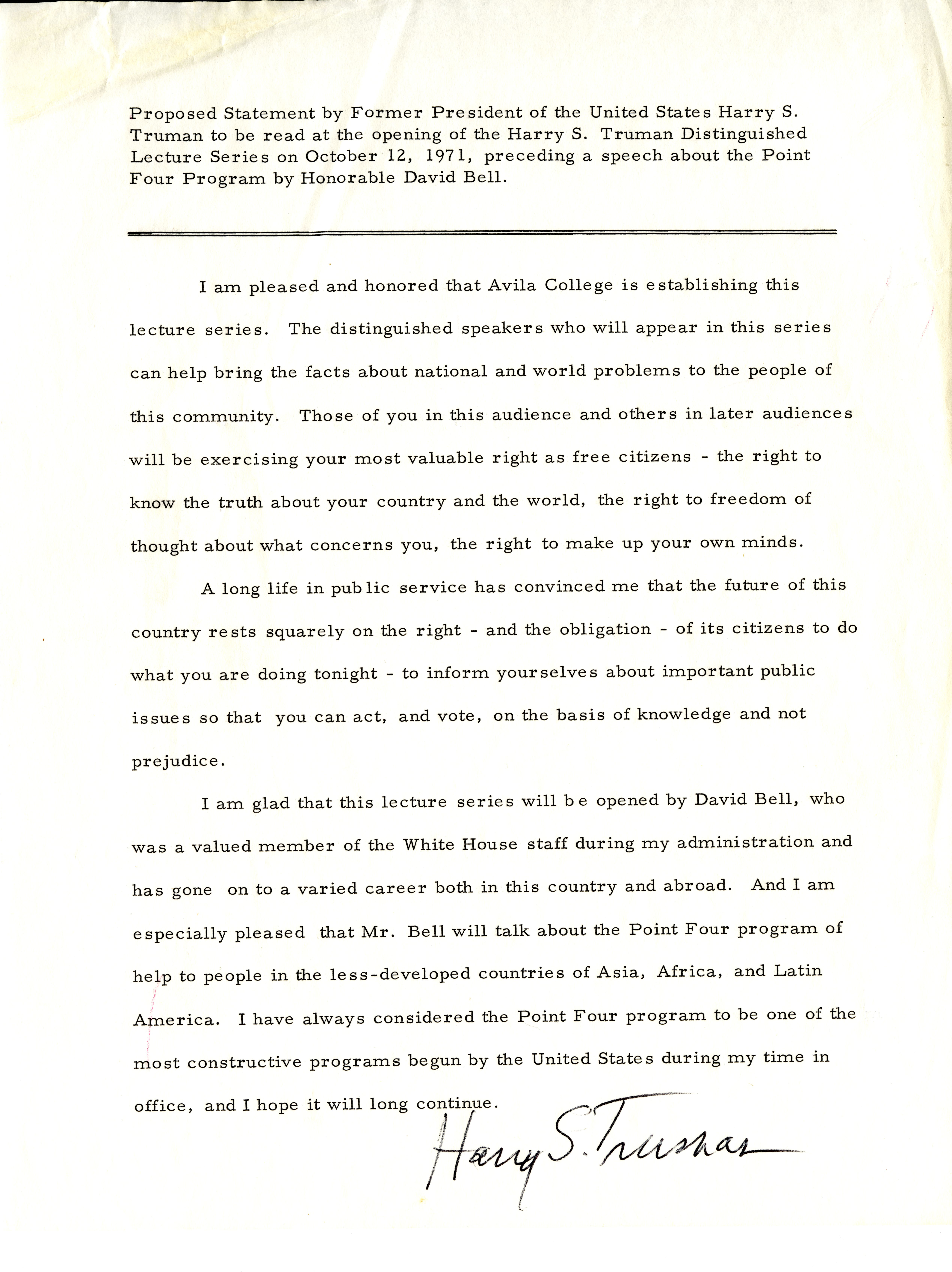
Since its founding, the series has welcomed distinguished voices who bring insight into national and global issues — continuing Truman’s conviction that education and open dialogue are essential to a healthy democracy. Today, the Truman Lecture Series stands as a lasting testament to his legacy and Avila’s commitment to thoughtful inquiry, public service, and the formation of engaged citizens.
On January 29, 2026, Avila University was honored to host a truly unique evening — a living conversation across generations of presidential history. A Dialogue with Descendants brought together Clifton Truman Daniel, grandson of Harry S. Truman; Mary Jean Eisenhower, granddaughter of Dwight D. Eisenhower; and Merrill Eisenhower, great-grandson of President Eisenhower, for a candid and deeply personal reflection on leadership, legacy, and what it means to carry a family name shaped by history. Their conversation embodied everything the Truman Lecture Series was created to foster — open dialogue, thoughtful citizenship, and the belief that understanding our past is essential to navigating our future.
Transcript
Moderator (Opening Remarks):
Andy: I’m not the center of attention so don’t worry about that. Welcome everybody. Thank you for being here at Avila University today. I first of all want to thank all the folks that are on the live stream — say hello to all those folks that are watching from afar. I want to also thank the presidential libraries for Truman and Eisenhower and all the folks from those institutions that have helped us with this day as well today.
On behalf of everyone here at Avila University and this whole community, we feel like this is a great privilege to welcome these folks here for our 2026 Truman Lecture Series. It is going to be an evening that reminds us of the enduring power of dialogue, service, and shared humanity. And this is a time for us to be reflective of that.
Today we are honored to have the members of both the Truman and Eisenhower families with us tonight — Mary Gene Eisenhower, Clifton Truman Daniel, and Mel Eisenhower. Your presence, ladies and gentlemen, here is not only a gift to all of us, but a living testament to the possibility of reconciliation, respect in public life, and the possibility of both. You carry forward two remarkable legacies of leadership — one that sought peace, understanding, and the better angels of our nature.
I want to offer special thanks to Joe Fehee for his generosity in underwriting this year’s event. And to our many friends, alumni, and our VIP donors whose ongoing support makes gatherings like this possible. Your belief in Avila and our mission allows us to convene important conversations like this one — conversations that model what we hope to see more of in our world today.
Here at Avila, we talk about civil discourse not as an abstract ideal, but as a daily practice. It’s in the way we debate ideas in our classrooms, how we compete on our athletic fields, and how we collaborate across departments and faith traditions. It’s the belief that disagreement doesn’t have to be division and that respect and reason still have a place in American life.
Tonight’s conversation reminds us that even two presidents — men who once stood on opposite sides of the political aisle and even shared a public feud — could find friendship, common purpose, and mutual respect. That’s a message we need now more than ever.
So thank you for being a part of this evening, for your curiosity, for your generosity, and your faith in the power of dialogue. May the stories and reflections you hear tonight inspire us all to lead with integrity, to listen with empathy, and embody the dignity that defines both our nation’s best history and Avila’s enduring mission.
Please join me in welcoming tonight’s moderator, Mel Eisenhower.
Mel Eisenhower: First off, thank you very much for having us here today. What a great series this is and it’s a true privilege and honor to be here. I have the unique opportunity to actually introduce two people — one I’ve introduced a couple times in my life. That would be of course Clifton Daniels, and he’s been a wonderful friend of the family. We’ve loved him for a long time. I’ve known him for over a decade and we go way back.
But my thing is — my mother is Mary Gene Eisenhower. She is the granddaughter of President Eisenhower, and of course I have the honor to introduce Clifton Daniels, who is the grandson of President Truman. And our family history does go back all the way to the presidencies. It’s kind of an interesting dynamic and relationship that we’ve had there.
But in order to get to talking about things like the feud and other things, if you guys don’t mind — maybe talk a little bit — I’ll start with you, Clifton. Maybe we talk a little bit about the political history of Truman because not everybody understands what happened during his presidency, during the war. Not everybody here may know all the history behind it, but I think it would be very interesting to hear your perspective of that. And it’s my first time actually being able to ask you this. So if you would please — I’m very interested in learning about this.
Clifton Truman Daniel: Okay. Thanks, Mel. Thank you, ladies and gentlemen, for being here. I’ll try and give you the not-the-David-McCullough version of this because we don’t have time.
So grandpa started off life on a farm. He was a farmer early in his life. Went all the way through high school. Couldn’t go to college — couldn’t afford it. Went to work with his father on the farm in Grand View, Missouri for almost 12 years. After that, served in World War I as an artillery captain. After he came back from the war, he ran into his old friend Eddie Jacobson, his canteen sergeant. They’d had the only successful canteen on the base. So they reasoned that they could make a go at business together, and they did for one whole year — Truman and Jacobson Haberdashery. The post-war recession tanked him. And after that, grandpa went into politics.
He asked Eddie if Eddie might want to join him in politics, and Eddie said, “No, thank you. I’m going to try and find legitimate work.”
Grandpa went into politics, served with the backing of the Pendergast family. Grandpa served two years as eastern judge of Jackson County. Lost the next election — the only election he ever lost in his life. Won the next election, which was for presiding judge of Jackson County. That was a four-year term. And he won again. So he served eight years as presiding judge of Jackson County.
And during that time, he is most well known for having rebuilt Jackson County’s terrible roads and doing it without throwing money to Pendergast’s crooked contractor buddies. Prompting Pendergast to tell these guys — they came into the office and they said, “Why aren’t we getting the contracts?” And grandpa explained that their bids were too high and they built bad roads and they all left in a huff. And Pendergast said, “See, I told you he was the contrarious son of a [—] in the whole state of Missouri.”
So he went from there to the United States Senate in 1934, served in the Senate for 10 years. He said it was the happiest 10 years of his life, best 10 years of his career. And after that was nominated as President Roosevelt’s vice president. Grandpa’s thought about the vice presidency was there was a woman who had two sons — one of them became a sea captain, the other became vice president of the United States. Neither one of them was ever heard from again. So he did not know where this was going to go, but as you all know, it led to the White House when President Roosevelt died on April 12th, 1945.
Grandpa served out that term and then won election in his own right in 1948 and served out the other term until 1952, at which point somebody else took over. Great transition.
Mel: Same question to you — just a brief history about President Eisenhower, your relationship and all those things.
Mary Gene Eisenhower: Okay. He was born in 1890 in Kansas, and I always said that granddad and Truman were cut from the same cloth and that’s one of the reasons that they actually had their little disparity. But anyway, we’ll get on to that later.
He had never been out of Abilene, Kansas until he went to West Point in 1912. And he met my grandmother in 1916. And then he went all over the place. They traveled — I think they had like 43 homes or something in 50 years. Insane. Isn’t that crazy? She always said, “If you put your rugs out and an ashtray, you’re home.” That was her way of coping.
And the china — she loved china. She would collect china like the rest of us collect hairbrushes. She had a set for everywhere they lived, all the way from Fort Lewis, Washington to wedding presents of her own and everything. But anyway, she had a ton of them.
But one thing about both of my grandparents is that if I could choose grandparents, I would have chosen them. They were truly truly wonderful. And I think what I loved the most about both of them was that they were just knee-slapping grandparents. They never made us feel like we were anything special except to them.
And I knew that granddad lived in a large house in Washington, but I didn’t realize there wasn’t a mortgage on it. And I can remember when I was about 32 or so, there was a celebration for granddad’s 100th birthday and I needed to use the ladies room and I thought that was probably in the same place as it was before. So they gave me permission to go down and use it. And I opened up the door and there were these beautiful crystal sconces and I went, “Oh, Mimi’s sconces are still here.” And then I went, “Oh, they never were Mimi’s sconces.” So it was a little confusing there for a while.
But anyway, overall, maybe I didn’t know him best as president. Maybe I didn’t know him best as army general. I knew him as my grandparent.
Mel: I think that’s great. During the Eisenhower and Truman administration, that time period of the world is unique. So when you think about your two grandparents, you think about where they started, whenever they were born — we’re talking horse and buggy — all the way to the time that they died, we had people on the moon. That’s a huge transition in history when you think about it.
I guess my question is during World War II these two leaders — and they were completely different styles, different types of people — but they were able to come together and actually end the war and come out with a positive outcome for Europe and the United States. I would love to hear both of your perspectives on how that happened and what role each of your grandparents played in that.
Clifton: Thank you. For grandpa of course — and there’s a line in the play “Give ’em Hell, Harry” that I do — “I never saw myself as president. I was just in the right place at the wrong damn time.” And so here he is thrust into the White House, thrust into the presidency. And he fully committed to continuing President Roosevelt’s prosecution of the war, which he did. And of course General Eisenhower was an integral part of that.
My grandfather was — and as you put it a minute ago, despite their little difference later, their little problem later — grandpa was a huge Eisenhower fan and believed in what he was doing, believed in how he was carrying out the war. And was so much of a fan of General Eisenhower that when he came back after the war, grandpa offered him the presidency. Just said, “Listen, next time around, you run. I’ll be vice president. It’ll be fine.” And of course the general didn’t know what to do with that. “Well, thank you very much. That’s weird.” And then grandpa did it one more time.
So he at that time also had huge respect for the military, for soldiers — having been in World War I, having fought as an artillery captain, having always wanted a career first and foremost as a soldier. He wanted to go to West Point, but his eyesight kept him out. He was even prepared, I think I heard once, to accept Annapolis — he’d just go to sea, anything to get into the military. But again, the eyesight kept him out. So tremendous respect for the army in general and for the way that General Eisenhower was carrying on the war.
Mel: Did you have anything to talk about with President Eisenhower’s side or General Eisenhower at the time?
Mary Gene: Yeah. After World War II, I think one of my favorite pictures actually — I’m kind of diverting now — is of your granddad pinning my granddad a military decoration.
Mel: I was hoping they weren’t fighting, but that would be interesting. No — pinning. Pinning. Got it.
Mary Gene: But he looked at all the troops, male and female, as his own. And he had lost a son when he was three and a half years old. And somebody asked him one time what was the worst thing that he’d ever been through. And he’d been through World War II. He’d been through a presidency. And without even stuttering, he said, “Losing my son.” He said, “Things are never the same.”
And I think during World War II he looked at the troops as his own and I think he definitely felt that way. And even 25 years after World War II, he and Walter Cronkite went to Normandy — and it was the first time back, and actually the only time he ever went back. And there’s a really almost tragic looking picture of him walking along the graves.
But the worst part was that night at dinner — he was the keynote speaker and he opened it up to Q&A, and this gentleman, and I use the word loosely, just flat said, “Did you ever kill anybody yourself?” And with that, he took his hanky and totally covered his face and he cried. Whether or not he pulled the trigger or whatever, he felt a personal responsibility for all of them. And I think that’s one of the reasons that he led as well as he did because people understood.
Mel: I think that’s a great answer. Thank you very much for sharing that.
In today’s political climate, there’s been a lot of talk in this country about NATO. Your grandfather was the first president to preside over NATO and your grandfather was the first commanding general of NATO. Who was better?
Mary Gene: Apples and oranges. Different jobs.
Mel: So my question is — because I think this is super fascinating when you think about it — you have two boys from the Midwest sitting in one of the highest positions in the whole entire world, being the president of the United States. They understand the League of Nations collapsed and they understand why, and they understand they have to put things in place. They have this threat of communism going on from Russia and they understand that this is a problem. And somehow they devised an idea to get Europe to come together, and the United States would also join this. Do you have any insight on how your grandfather helped lead bringing NATO together?
Clifton: Well, he liked the idea of the League of Nations, which never, as you know, never got off the ground. And when it came to NATO, grandpa likened it to a group of homeowners who are allied against a rotten landlord — meaning the Soviet Union. He always believed that in numbers and in helping each other, that’s where the strength is. Common cause and sovereignty, national sovereignty, protecting your own borders, protecting your own people, your own way of life. Nobody has any right to take that away from you, although human beings do it over and over and over again throughout history.
For him, it was a very practical, simple solution. And I don’t know all of the nuts and bolts of how he got it done. It was already in the works, but he got it done by being behind it, by being the face of it, by saying, “This is what we need to do. We’re going to help. We don’t want this to happen again.”
Mel: And then General Eisenhower was actually out of service and your grandfather had to make a decision of who was going to lead this. Mom, was there any insight that you might have? Did John talk about how he got pulled into — roped into — being the first commander of NATO? Because he was pretty much done with war and being in the military. One of my favorite quotes that he has is, “I can only hate war the way a soldier does.” So I’m curious if you have insight on that, or if you do, Clifton — how did Truman pull him? He was president of Columbia University. That’s a great job. There’s a lot less stress than coming back to NATO.
Mary Gene: Well, first of all, I think that he kind of thought of academia — no offense to anybody here — as kind of a bore. And he really missed being in the military anyway. So he was kind of the logical choice. He had all the credentials and the experience. And also he and de Gaulle — it was originally located in Paris, France — he and de Gaulle were about the only two that really truly got along on both sides, and they had a tremendous amount of respect for each other. And I think that had a lot to do with it too.
In fact, when granddad passed away, de Gaulle was the first head of state to drop everything and jumped on a board an airplane and came to the States before the invitations even went out to the funeral. And my sister and I decided to go incognito that night and we were going around the Capitol Rotunda, and all of a sudden there was a ton of noise and security had just gone bananas at the front door, and out from security came Charles de Gaulle, and he went straight over to granddad’s coffin. And I’ll just never forget the friendship there. But it had been going on for a long time. And I think once granddad left NATO, they got kind of kicked out of France. So I don’t know if that’s got anything to do with it, but anyway, the Belgians were so welcoming at that point.
Clifton: And I was with my grandfather in Key West when President Eisenhower passed away. And I remember — you always, grandpa was getting older at that point, this is 1969 — so you were always supposed to behave yourself around him, don’t run too much, don’t shout. But I remember when he got the news he just shut down, he just wanted to be by himself, and everybody was walking on eggshells around him that day.
Mary Gene: And actually they died friends.
Clifton: Yeah. Which people wouldn’t have really realized during the peak of their — I’m actually getting there because we’re getting there, I promise.
Mel: We jumped the moderator. You did. You can’t do that. That’s against the rules. You read the rules. You signed it and agreed to it before we started.
So let me ask this question. So in 1948, we know that Truman asked Ike to run as a Democrat. And Ike decided that the Democrats have been in power for a very long time and decided to be a Republican, because Ike never voted for anybody but himself — that was the first time he ever voted. And my question is — I don’t actually know this, so I’m glad that I have two perspectives — I know that there was an issue that happened. I know that Truman pulled John, my grandfather, off of the front lines in Korea, and that was something that Ike didn’t want. But I don’t know if there’s anything else that went behind that, if it was political or anything else. But for some reason there was a public dispute that is found in movies, is written about, you see it everywhere — it’s a huge piece of history — where Truman and Eisenhower had this feud. I’d love to hear your perspectives on how that happened, what that meant, because it’s the first time in history that happened. Whoever would like to start.
Clifton: Well, for grandpa — when he ordered John Eisenhower, Mary Gene’s father, home, the simple reason was that he thought that the new president’s son should be there for his inauguration. And of course incoming President Eisenhower didn’t like that. He thought that was favoritism. And so I think his comment to my grandfather was, “I wonder who ordered my son John home from Korea,” and grandpa turned to him and said, “The president of the United States did.”
Yeah, it was not the fuzziest warmest thing between them. But it seems like a bunch of cascading misunderstandings. They — I joke that of course grandpa’s reason for getting miffed in the first place is because Ike decided to be a Republican. Grandpa offered him the job twice. Like, well, great. Thanks a lot.
And then there was the defense of General Marshall. This was all political, right? Grandpa thinking he should do one thing and President Eisenhower thinking he should do another. And this was all political maneuvering.
And the final one — the one that grandpa got really bent out of shape about — was that by this time they were already fractured, they’d already had enough misunderstandings. And then grandpa had — this is actually codified now — when one president leaves and the other comes in, there is a process for moving the new president and his staff into the White House that grandpa began. And so what he was trying to do was share information. “Here’s — come and talk to my people. Come on. Come anytime. Talk to our aides, talk to the cabinet members. Get the feel for what we’re doing so that the transition is smooth.” But President Eisenhower viewed that as trying to massage his administration, trying to lead him in a way that he did not necessarily want to go. But by that time, it seemed that no matter what either one of them said, the other was going to take it the wrong way. So it just wound up being an unfortunate mess.
Mary Gene: That sounds right. And you know, they were both Midwestern boys cut from the same cloth. And they were both stubborn.
Clifton: They just — it kind of seemed like it was inevitable but the story I like — the way you told it — was how they made up at Blair House. The way I understand it, at John Kennedy’s funeral both of them were there, and Mrs. Kennedy, having way too much to do and being crushed at the time, did not make a lunch allowance for President Eisenhower, and grandpa and my grandmother were staying over at Blair House. It wound up that grandpa told President Eisenhower, “Well, come on over to Blair House.” And somebody — I don’t know if it was my grandfather himself — but somebody made Ike a sandwich and fed him. And they just sat in one of the front rooms at Blair House and hashed it out and walked out friends after an hour, just sitting and having a sandwich. So it didn’t take them long to unravel. I think both of them were tired of it by that point, frankly.
Mary Gene: Well, and I always thought it was kind of interesting that the death of one president brought the other two back together.
Mel: During their presidencies, both presidents accomplished quite a few things. I’m curious, Clifton, if you would tell me what you think maybe a couple of the top accomplishments of your grandfather might be, because I have my own. And then we’re going to go the other direction too and I want to see what we think about some of the things that they did wrong as president of the United States as well.
Clifton: Well, that’s going to be short because it’s nothing for either one. Okay, fair enough. Here we go.
I always — you know, there are the big decisions. There’s the end of the war in the Pacific. There is the Marshall Plan, the Truman Doctrine, the desegregation of the military, the recognition of Israel — all of those well-known big decisions that are still with us to this day. In fact, the Truman Library, as part of the 250th anniversary this year, has some National Archives documents coming up on display, and the Marshall Plan and the Truman Doctrine are two of the documents that they’re going to have on display.
Also, the Louisiana Purchase — which may or may not have been signed. France may still own us.
Mel: That’s not the same time period.
Clifton: No, no, not the same time period. Just thought I’d throw that in there. Just doing my math up there because I’m sort of astounded that the Louisiana Purchase — there’s actually a document with Monroe’s signature at the bottom.
But anyway, those are the big decisions. And then of course I can always make the joke that one of the best decisions he ever made was vacationing in Key West, because I still get to go down there.
Mel: I mean, that’s fair. And your mother does too. So it’s a haven for presidential descendants in February.
Clifton: But I think more seriously, I think one of his greatest accomplishments — and you alluded to this earlier about both of them — was showing the rest of us that a farmer, citizen soldier, a haberdasher, small businessman, county judge, US senator can rise to the highest office in the land and do a better job of it than almost anybody else. And that’s the promise of this country. That to me was a great accomplishment.
Mel: Actually, if I’m not mistaken, Truman is the last president without a college degree. Is that correct?
Clifton: Correct.
Mary Gene: And Ike was the last general.
Mel: I think that’s right. Kind of interesting. Different times, right?
If you would also maybe talk about some of the greatest accomplishments that Ike had as president of the United States, I think that would be helpful for the audience. Again, not everybody knows these things.
Mary Gene: Okay. Well, of course there’s the US highway and defense system. And it was considered to be a military exercise. And I don’t know if anybody knows this or not, but every five miles on like I-70 or whatever interstate, there is a mile of stretch that’s completely straight and completely level, and that was for airplanes to land. So that was a pretty good one.
People-to-People International — that was one of his. And then there was the Small Business Administration. And NASA, of course. Yeah, there are quite a few.
Clifton: I mean there are others like the Civil Rights Act. He was the first president to pass legislation on that, which is interesting because Truman was the first president to enact an executive order on civil rights, which was integrating the army. And then Ike was actually the first president since the Civil War, since Reconstruction, to pass any laws on civil rights.
Mary Gene: Well, and he interestingly took — wasn’t it the 101st Airborne? — to Little Rock to make sure that the school got integrated.
Clifton: Absolutely.
Mel: And that’s a unique thing too, because there’s only been so many presidents that have actually implemented the actual regular army and put them into a state. And this stuff we’re starting to hear now currently on the news. So we’re hearing things like is the National Guard going to get called up in certain places?
What we’re seeing — and I don’t know if you’re seeing this too, but this is what I see anyway — is that we have a Republican and a Democratic president that may not have agreed with each other 100% of the time, maybe not even 60% of the time, but they were able to work together to improve this country to heights that it never had been. At the very beginning, you remember when they started their lives, they were walking and riding a horse, right? And by the time both of them died, we had a man on the moon. And they navigated the middle part of that flawlessly.
And they were two different people with two different parties and two different ideas. And somehow they came together and worked through civility. I would love to hear your perspective, Mom. You have a global perspective especially with your background with People-to-People International and the world peace that you’ve worked on. How do we get politics to stop being a focus of the new religion where we’re judging people based on their political party and not their character? I’d love to hear some thoughts that you might have with that.
Mary Gene: Well, right now that is a huge challenge. But I still believe that if you get people face to face — not screen to screen, not internet to internet or whatever — if you get people face to face and have them work on mutual projects that don’t require the same language, or you travel to visit each other’s cultures and that kind of thing, I firmly believe — and I saw it happen myself — where people just, it’s amazing how they melt away. And most people in this world want peace. They want a — it’s just a handful that keep the airwaves going. And I really believe that granddad knew what he was talking about. I mean, he saw it a lot while he was in Europe and that kind of thing.
Mel: Clifton, I pose the same question for you. And we just — I just worked today a little bit on trying to — some of our fellow descendant buddies got together and wrote an op-ed that I’ve pitched to the Chicago Tribune just today. George Cleveland, Massie McKinley, Tweed Roosevelt, and Ulysses Grant Dietz. It was talking about the loss of empathy in this country, the loss of kindness, and we used examples from our ancestors.
Teddy Roosevelt — although the newsies in New York, the news kids had lived on the street and were a nuisance. The police roused them all the time. He was police commissioner and a kid had lost his day’s earnings — about three bucks — down a gutter, and Roosevelt took pity on him and gave him five.
And McKinley — President McKinley shot by Leon Czolgosz — his first thought was for the assassin. People were jumping on him getting ready to tear him limb from limb and he told his secretary, “Please don’t let them hurt him.”
So this kind of kindness — Grant accepting Lee’s surrender at Appomattox, never thought of taking Lee’s sword. It was a ceremonial sword given to him by fellow officers. They’d been friends. They’d fought together. And Grant reported being depressed afterwards. He did not feel like a victor. He was just sad that his enemy had fought so long and so hard and was now humbled in defeat.
So that kind of presidential kindness, empathy, understanding — you’ve got to make tough decisions, you’re going to cost people their jobs, their lives no matter what you do. But if you can show some kindness, if you can show some empathy — and we’ve lost a lot of that — people are just mad at each other in this country.
I have to hope they run the thing in the Tribune. We thought we’d pitch it to the New York Times first, so I sent it to the Tribune with a title “Times Op-Ed” and then I had to write them a second email and lie saying, “No, I meant timely.” We’ll see if that flies.
Mel: The other part of it is that the effort was made. Thank you. This is why we’re friends.
The other part of it is we’re talking about history a lot tonight, but we’re also talking about two individuals that were on complete polar opposites on the political spectrum. Not what we see today — it’s different now. But I have a real fun question, just a fun one. Do you think that Dwight David Eisenhower would be elected as Republican president today?
Mary Gene: No.
Mel: And he’s considered one of the best Republicans ever. Do you think that Harry Truman would be elected as a Democrat today?
Clifton: No. And I think you know what you’re saying — they weren’t really polar opposites. And that was the beauty of the way the system is supposed to work. They weren’t that far off. They had different ideas about how to do things, but they were both more to the center than what we’re looking at today.
It’s just — John Avlon, Margaret Hoover’s husband, CNN — John wrote a book years ago before this all really became a daily headache called “Wing Nuts.” You know, we’ve been hijacked by the far right and the far left. People have just pushed to the edges and we don’t have — we’re losing our center.
I have this at home. My house is between a Trump hat-wearing conservative on one side and a flaming liberal on the other, and my wife and I are stuck right in the middle going, “Oh god, what are they going to do if they start shooting at each other?” But that’s the country. I think most of us would like to be in the middle, would like to have a give and take.
Mary Gene: Well, that’s the advantage of having one son. I’m just confused all the time. So it’s fine.
Mel: So I think this is important to understand because I think that your relationship is important. I think it shows a symbol of how — people first of all, friendships are friendships — but to me I think it’s important because it does show that even if you come from different sides of the political aisle you still can be friends and hang out and still be Americans. I’m real tired of the hyphenated American part. We’re all just Americans first, right?
I’m curious if you guys would share why your relationship is important to you. Like, why is being friends with Clifton so important?
Mary Gene: I will say it’s very special with Clifton because we are both in the middle and we get along that way. He makes you laugh. He’s a lot of fun and he’s one of my best friends and I love it.
Clifton: True. I’m trying to remember when we first met because it seems like we’ve known each other for ages. I was told that I was invited to be grand marshal of the Royals. Right. That’s what it was. And I was told that Clifton was also going to be grand marshal and we were going to do this thing together. And I remember telling the organizer — I said, you know, I live in a Truman house in Independence, and he said, “Oh, no, no, no, no, no.” He said, “I am not going to tell another Truman that Eisenhower has moved in and taken over his house.”
And the other time too — I was about three-quarters of a mile away in Independence, the house was near to the museum, and I said, “Clifton, you come to Independence all the time. Why don’t you come over and I’ll scare up some tea or something like that.” He says, “Yeah, well I’d come in.” And Pauley’s on the other end going, “Clifton, Clifton, that’s not nice. What are you talking about?”
But it just seems like we’ve known each other forever. And among other descendants as well — great grandchildren and great great grandchildren. It’s a weird legacy, a weird bond. Well it is a bond because we geek out over each other’s families too. Somebody tells me, “Oh, you’re going to meet Mary Gene Eisenhower.” You know, another president’s grandkid. Cool. I wonder what that’s like. Duh. It’s kind of like what you’re living through at the time. But we do — it’s very easy for us to all get along.
And I told a couple of folks — when we came to visit Mary Gene in Abilene, last year we had some descendants visit the Truman Library. Two of them went home in great sadness and five of us got in a car and went over to visit Mary Gene. And on the way back, in the back of the car, I’m sitting between Tweed Roosevelt, Teddy’s great-grandson, and Massie McKinley, who is President McKinley’s — he’s President Cleveland’s great-grandson. He’s got two presidents. We call him double whammy.
And Tweed made the tactical mistake — we were just chatting on the way back from Abilene and Tweed made the tactical mistake of showing us a picture on his phone of him at age nine stark naked swimming at a quarry. So Massie and I are now starting to laugh. And then he said, “Yeah, and at the time one of my nicknames was Sweetie.” Well, now we can’t stand it anymore. So we’re snorting and laughing and calling him names. And in the front seat, Linda Johnson Robb says over her shoulder, “It’s like riding with a bunch of 12 year olds.” And the driver, Ulysses Grant Dietz, says over his shoulder, “Don’t make me come back there.”
So we all have a good time together. We have this shared legacy, and I think frankly we kind of glory in the fact that we all get along. There’s no reason not to and every reason to get along and it’s just fun and it’s a positive thing. So it’s — but I mean you were — this sounds terrible — you were kind of my first.
Mary Gene: Wait, you and Susan Ford. Okay. I’m doing pretty well.
Clifton: But it’s Republican women. Well, that’s what it is. Trying to get Democrats to go to Key West was like pulling teeth. I suddenly realized I’m surrounded by Republicans. And finally, finally the Johnson sisters showed up, but that was about it. And they won’t come back.
Mel: Well, I appreciate that. Given the time, I think that’s probably the last question that I have for now. But I would like to open it up to the audience to ask these two wonderful panelists any questions that you might have, within reason. I’ve done that before and it’s gone really south really quick. I’m just kidding. No, please — anybody that has a question. I cannot see you so I can’t point to you. And I believe there’s a microphone that can be passed around. There’s somebody in the middle, I think, or they’re waving at me. I’m not sure. Clifton, do you see somebody?
Audience Member 1: Thank you. This isn’t a question, it’s more of a reflection. You just talked about legacy and I’m saying that I am legacy because my dad was Normandy to the Battle of the Bulge — of which President General Eisenhower — and then he didn’t have enough points and he would have gone to Asia, and because of the dropping of the bomb, President Truman, he stayed alive and thus I exist in an existential kind of way. So you walk in the family of history all the time and I do also.
And one more thing — when I was about four, I met President Truman, retired then, in 1969 when I was in the parade. And my dad was following along to make sure that I was okay because I was just four, behind the Shriner horses if you can imagine. And when we got to the house, my mom and dad had said these very important people might come out, and they did. There was a hush and then people clapped. My dad came in from the side, put me on his shoulders and said, “That’s the man who saved my life.” And he was crying. Now I didn’t really understand all that that meant then. I will never understand what it was like for him. But I exist because of your two granddads and great-granddad.
Clifton: That’s wonderful. Thank you.
Audience Member 2: So to the Eisenhower — happy Kansas Day. Thank you. So as presidents, it’s such a stressful job. So were there personal routines or habits or personal practices that allowed them to deal with the stress of being the president of the United States during these tumultuous times?
Clifton: I have actually never even heard that question before in my life. I’ve never gotten that one. That is a very interesting and good question. I appreciate that one.
Mary Gene: My grandfather loved those little machines that go — wamp, ball, wamp — like that. And he would play with those forever even while he was thinking. But that was one of his things. And then bridge.
You’ve heard of the Eisenhower Matrix as well, right? You should look up the Eisenhower Matrix. It’s a way to manage importances and tasks and he kind of invented it — I don’t know if he invented it or learned it at West Point or somewhere — but it kind of goes like this: important urgent, important not urgent, urgent not important, not important not urgent. And so he would task every single one of those things and put them there so that he knew what was actually important, what he actually needed to do, what actually didn’t need to happen at all, or if he felt like doing it he could do it.
The other saying that I liked the most was “illegitimi non-carborundum,” which means don’t let the bastards get you down. So that’s also one of my favorite ones as well.
Clifton: Grandpa’s was similar but simpler — bourbon and poker. So nothing’s changed.
Actually his doctor, Wallace Graham, prescribed — he had stress-induced heart palpitations, which I also get, thank you grandpa — but his doctor Wallace Graham said, “Just start your day with a shot of bourbon.” And grandpa was one of those people who could do that and then go through the day, and sometimes one again at night, but he never wanted more than that. So it was actual medicine. Medicinal bourbon.
Audience Member 3: So first of all, thank you so much for coming and sharing a great story. Just a random question — what international decision made by President Truman do you think still affects the world the most today?
Clifton: Well, I think the one is the rebuilding of Europe in the various — the Truman Doctrine, the Marshall Plan, NATO — the reordering of the world against aggression following World War II. That is in extreme fluctuation right now given the current world view and American view. But those decisions have been in place — we’ve been living under that for 80 years. Those are still the decisions I think still matter. Still in effect.
Mel: I want to point this out too, and I’m very grateful for NATO. But Europe should be more grateful for NATO. In European history, if you read a book about it, you’ll see things like the Hundred Years War, the 30 Years War, the Seven Years War, the Crusades, minor skirmishes, the sacking of Milan, the fall of the Roman Empire. Europe has always been at war with each other. Always. And because of NATO and because of the foresight of the two men that we’ve been talking about today, it has allowed Europe to live in relative peace for 80 years, 81 years almost. That is unheard of in a history book if you ever pick one up and read about the actual devastation that Europeans have been doing to Europeans.
So it’s really remarkable that this alliance has stayed in place and it’s allowed for Europe to grow economically and not have to put as much towards military, because the United States has been involved, allowing them to do other things like humanitarian work. It’s been very very interesting to watch. So if you haven’t read about the Hundred Years War, I suggest you pick up a book and read about it because it’s pretty crazy when you start thinking about it.
The other thing I want to do is recognize my wife down there, Nicole. Can you wave your hand real fast? She puts up with me all the time. I just wanted to say hi to her.
Mary Gene: And she’s really happy you did. You can tell by looking.
Audience Member 4: So first of all, who organized the Descendants Club? And have you ever thought of collaborating on a book, especially about the car ride when there were six descendants?
Clifton: Most people think we should turn that into a reality series. The Society of Presidential Descendants as it’s formally called was created mostly in large part by Tweed Roosevelt and Massie McKinley. Tweed is the president, Massie is the sergeant-at-arms and vice president. Linda Johnson Robb and I are also vice presidents.
But it came about in 2018 for the annual White House Historical Association summit. They invite presidential sites, libraries, homes, birthplaces. They invite them to come to a summit. And in 2018, they had it in Washington, and for some reason that was the first time they ever thought of, “Well, can we find some descendants to come to this thing?” And Stuart, the president, got Massie and said, “Can you just give it a shot? Find a handful of descendants.” Well, I think Massie found 60, 70 right off the bat. And a lot of us showed up.
There are great pictures on my phone of me, Mary Gene, Susan, George, and a couple of others in the round bar in the Willard getting half-baked and coming up with ideas. But that’s what started it — he started that list and that list just began to grow, and Massie and Tweed just said, “We ought to do something with this,” and so they founded the society.
Every other year we give a book award on presidential leadership, and the years that we don’t give the book award we visit each other’s sites and libraries. As I said, they came to the Truman Library, we went over to see the Eisenhower Library, and this October we’re going to Austin, Texas to see the Johnson Library. And that’s just open to anybody that wants to go. That’s how it started.
Audience Member 5: How many siblings do you have?
Clifton: Oh, okay. I have two brothers. Neither one of them are involved much. I mean, my youngest brother has done some events with me and done some on his own, but no, they’re not as interested.
Mary Gene: I’ve got one brother and one sister. And David kind of does his own thing. And Susie just kind of goes off and does her own thing. Well, they both — Susan’s an expert in foreign affairs and she’s written books. And she was on the energy commission too, right?
Clifton: I think that’s right.
Mary Gene: I think that I have no siblings, besides you know — so I’m an only child. But if I did, I think they would be very involved. Sometimes I like to think they are involved. Oh wait, did I say that out loud?
Mel: Your mother is thankful that we only have one.
Audience Member 6: So President Truman was most recently portrayed — if anyone saw the movie Oppenheimer — and I think he got kind of a negative connotation because in the scene at the White House when he calls Oppenheimer a crybaby. So I was just curious to know how the Truman family felt about that portrayal, or even if it really happened, or the whole Oppenheimer relationship and how that was perceived in your family.
Clifton: Well, first of all, the Truman family wonders why, when you have a Truman grandchild who looks like his grandfather, actually plays his grandfather on stage, and is a trained actor, why you would ask an Englishman to do it. An Englishman — and Gary Oldman is a very good actor. Why they chose an Englishman and why they made his hair poofy, I don’t know. Those were my main complaints.
His actual — my grandfather actually did say that about Oppenheimer. I don’t think it was said in exactly that way. He may have written “crybaby scientist” rather than said it, but he was not happy with Oppenheimer. The deed was done — let’s not go on with the hand-wringing. And yet my grandfather hated having to make that decision. He hated the loss of life of women and children, civilians in Japan. And both bombs — if you know, the first bomb on Hiroshima was August 6th, the second on Nagasaki was only three days later, which grandpa thought was just a little too fast. He’d given it to the military and that’s when he took back control of the weapon to the White House, to the president, because he did not want it used indiscriminately. So it bothered him quite a bit. But he was not the kind of man who would put up with hand-wringing, especially from the man who spearheaded the invention of the weapon. So that part’s true, but so is the poofy hair.
Audience Member 7: I have two charming stories, short stories about President Truman and about President Eisenhower.
When I was about eight or nine, I was at the airport, the municipal airport, and President Truman was coming through, and my father — there were all these reporters around him and lights and photographers. And my father said, “Look kids, there’s President Truman.” And he was a little bit ahead of us, but he heard that. And he circled back around and all the photographers stopped and the murmur stopped, and he got down low and he asked us our names and why we weren’t in school and asked us several questions, shook our hands. And that was just a memory for our family, a wonderful memory to this day. The story is passed on down to the second generation in my family. And I’d always heard that President Truman loved children and that certainly was my personal experience with that.
And my other story about President Eisenhower was actually about your father, General John Eisenhower. A friend of mine in college was a daughter of a general, General Terry, who was friends of your father. And his children and you and Susan would play together, knew each other. And one time you were really little, I think it was you, and you were having a spat with General Terry’s daughter, and finally you said, “Oh, well, my grandfather’s the president of the United States and yours isn’t.”
Mary Gene: And that sort of ended the whole fight.
Mel: She still does that.
Moderator: I think that’s a great one to end on. Let’s give them a round of applause.
So again, we are so privileged that you are here and you’re willing to share your family history and the lessons that you learned from your grandparents. And I know I learned a lot tonight and I think the audience did as well. We have a small gift for you to commemorate this moment.
Thank you everybody.
A Legacy of Distinguished Voices
Over more than five decades, the Truman Lecture Series has brought to our campus some of the most compelling and consequential figures of our time — historians, activists, journalists, scientists, public servants, and survivors whose lives and work embody the spirit of informed citizenship that President Truman championed.
Past speakers have included:
- David E. Bell – the inaugural lecturer and former administrative assistant to President Truman
- Margaret Mead – renowned cultural anthropologist
- Nancy Landon Kassebaum – first woman elected to the U.S. Senate in her own right
- William F. Buckley – author and commentator
- Coretta Scott King – civil rights icon
- Sister Helen Prejean, CSJ – author and tireless advocate for human dignity
- Clarence Kelly – former FBI Director
- Joseph Califano – former U.S. Secretary of Health, Education, and Welfare
- Louis Zamperini – World War II veteran whose extraordinary story of survival was captured in Unbroken
- Jonathon M. Katz – investigative journalist and author
- Sarah Collins Rudolph – survivor of the 1963 16th Street Baptist Church bombing in Birmingham
- Reyna Grande – award-winning author
- William Kamkwamba – Malawian inventor and engineer
Each speaker has brought a unique perspective — and a shared belief in the power of knowledge, dialogue, and human dignity to shape a better world.
Details around our next session coming soon